
Why a Spec Is Not Completion: Evidence and Trustworthy Acceptance in Agent Development
Consider a development handoff. An agent passes data-adapter tests on revision A, then changes authorization logic to produce revision B. A live-data integration check never runs because an isolated environment is unavailable. The next session retains only “tests passed,” and the closing report eventually says “the new data source is complete.”
This is a constructed teaching example, not a recorded project incident. Its point is not that agents necessarily lie. A genuine local result can lose its conditions across revisions and summaries, becoming a stronger completion claim than the observation supports.
Our evidence mechanism addresses that gap. Here, engineering evidence means material supporting development conclusions, not the market sources cited in an investment report. The goal is not another document layer. A successor should be able to identify which requirement was checked, against which source and under what conditions, what remains unverified, and why this piece of work can end.
This article goes deep on evidence and acceptance. For the complete path through clarification, design, specification deltas, implementation and handoff, see Spec-Driven Agent Development.
1. What Is Missing When Spec, Git and CI Already Exist?
A spec describes intended behavior. Git preserves source changes. Tests check behavior under particular conditions, while CI can retain revisions, environments and artifacts. These mechanisms are valuable. The usual gap is that their facts are not connected to the final claim, not that any one tool inherently lacks the capability.
Adding a data source to a fund-research system may require source identity, access restrictions and failure recovery. A test showing that the adapter parses a mock payload supports only part of that promise. To judge the whole change, someone must connect acceptance commitments to coverage, blocked executions and any relevant modifications made after testing.
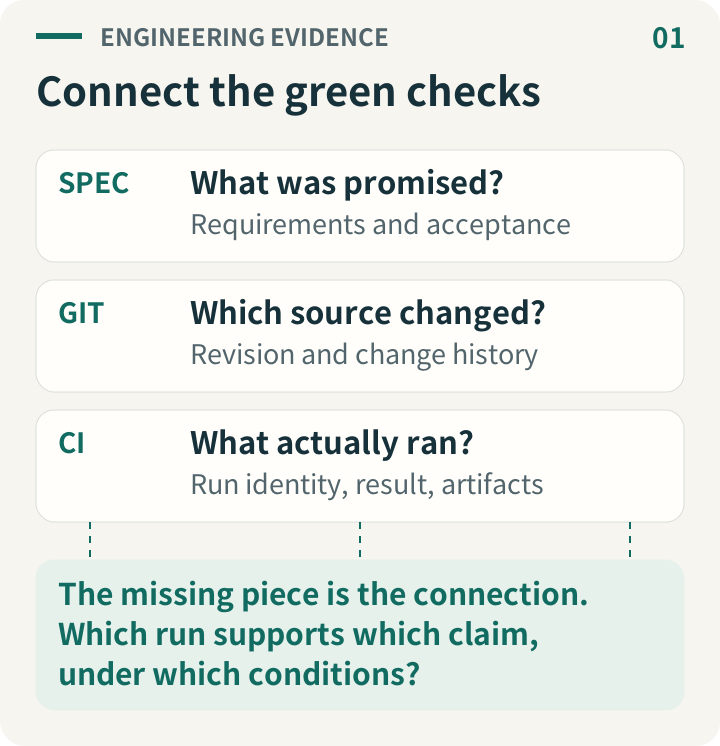
| Existing mechanism | What it directly answers | What still needs linking to the conclusion |
|---|---|---|
| Spec | What behavior is expected? | Which execution exercised which requirement? |
| Git | How did this source change? | Which actual working tree was observed, and what changed later? |
| Tests / CI | What ran, and what was the result? | Which acceptance commitments did those checks cover? |
| PR or handoff summary | What progress does the author report? | Does the conclusion lead to an original execution, rather than another summary? |
If CI already connects requirements, run identity, revisions, coverage and remaining gaps, it can be the evidence carrier. Using evidence.md in this article is not a reason to duplicate an adequate system.
For our Markdown-based, long-running, multi-session workflow, a lightweight ledger is an index that travels with the change. It mainly stores relationships and summaries. Original logs remain with their runner or artifact storage.
Why does agent collaboration make this more noticeable?
One agent can write the requirements, implementation, tests and final explanation. That is convenient, but producing a result and explaining it may share the same misunderstanding. A second agent that reads only the first agent's summary has not performed an independent check.
Session changes and context compaction can also change which material a successor sees. Implementation, testing and integration may occur in different working trees at different times. Human handoffs have the same problem; agents have not invented a new engineering discipline. They make it more useful to design explicitly for preserving the original conditions.
The benefit is therefore not another prompt asking an agent to report honestly. It is changing the handoff object from “done” into inspectable relationships. Reminders help, but should not be the only carrier.
2. Engineering Evidence Supports a Conditional Claim
Return to the new data source. The claim is: “Adding this source must not expand the user's data access.” After one denial test, the defensible conclusion is: “This exercised denial path in revision A meets the requirement.” That is still narrower than “every authorization path is correct.”
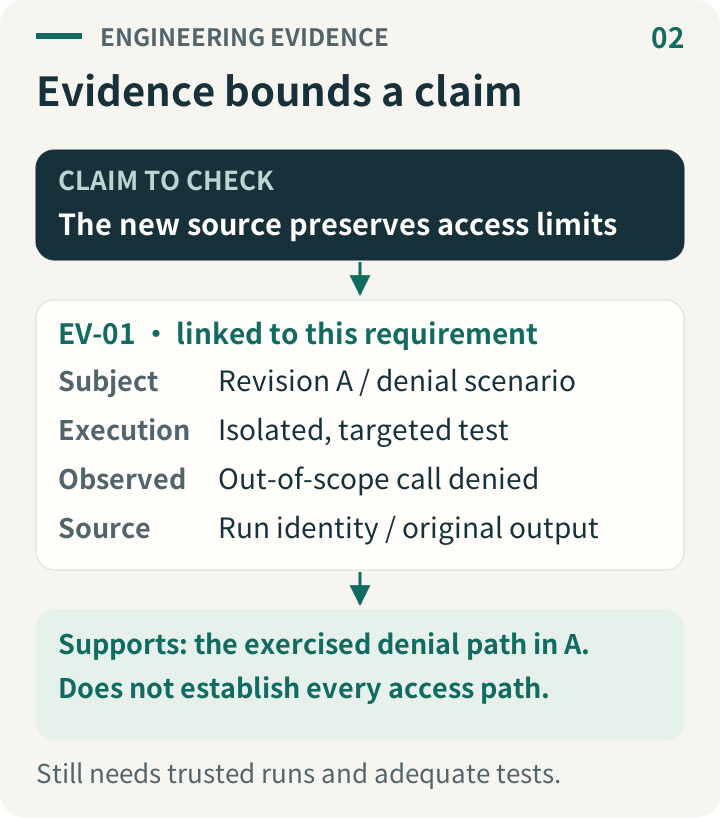
Useful evidence should identify the claim being supported, the observation that actually occurred, and the conditions under which it occurred. Revision, command, environment, samples and artifacts are not decorative fields. They constrain the relationship among those three things.
The following is a simplified teaching record, not an actual execution receipt or the public CLI's complete input format:
Evidence: EV-01
Claim: The new source must not expand data access
Task: 1.1
Revision: Actual source / working-tree identity at execution
Check: Targeted out-of-scope request in an isolated environment
Observation: The exercised request was denied
Artifact: Locatable run record and original output
Limit: Other access paths and live-provider behavior are not coveredEV-01 connects “why check this?” with “what was observed?” Its value is not the identifier itself. Reporting many passing tests without connecting them to the claim still leaves weak support.
Traceable, trustworthy and sufficient are different properties
Traceable means a record leads back to an execution and its artifacts. Trustworthy means there is reason to believe the execution record was neither fabricated nor misattributed. Sufficient means the checks support the particular decision being made.
A ledger primarily improves traceability and makes the other two properties easier to scrutinize. An agent that can edit the implementation, tests and ledger can make all three agree while misunderstanding the requirement. Another field does not solve that problem.
For important permissions or external effects, an existing CI runner can retain independent run identities and protected artifacts, while established review, testing and release mechanisms decide acceptance. That is a stronger trust arrangement, not an authentication capability already supplied by the Evidence Kit below. An existing file or a matching digest alone establishes neither a genuine execution nor sufficient testing.
Accordingly, observed-run means “the recorder declares this was an execution observed at the time,” not a trust stamp issued by the tool. The public toolkit documentation explicitly preserves that limitation.
A second easily missed form of evidence is the before state. Without a baseline, a passing result can support “the exercised conditions are now met,” but not “the system improved by this much.” Mark an unavailable baseline as not collected. Do not infer an attractive before measurement from an after result.
3. How Can Evidence Survive Revisions and Sessions?
An observation is first a historical fact: a result was seen at a particular time under particular conditions. A later commit does not erase it, but neither automatically inherits all of its evidentiary value.
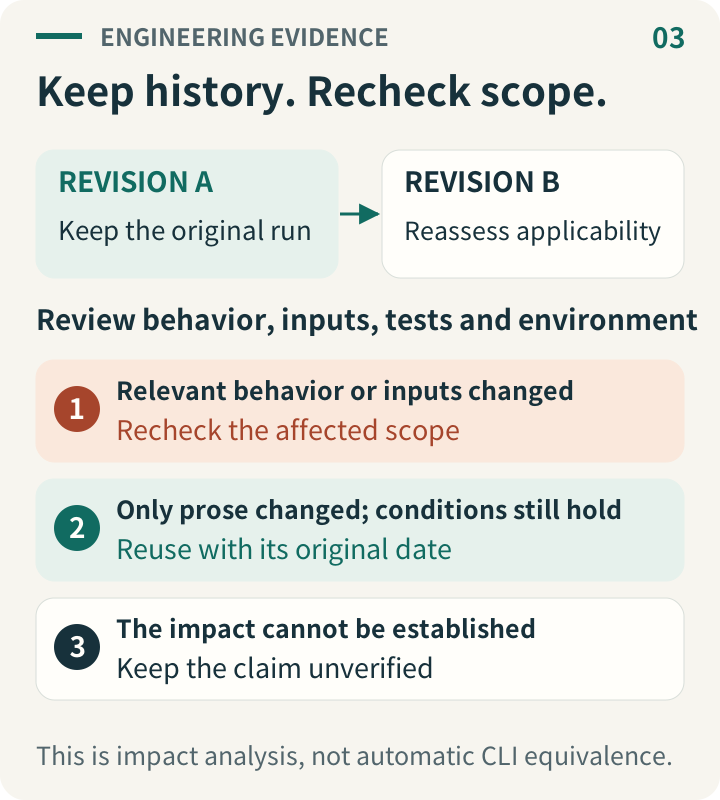
In the opening example, B changes authorization. Adapter tests on A cannot directly establish B's authorization behavior. Review which requirements, tests and inputs the change affects, then rerun the relevant scope instead of giving an old PASS a new date.
Conversely, correcting a typo does not necessarily alter behavior, configuration, samples or external conditions. A valid closure record should not force a full rerun solely because the commit identifier changed.
| Recorded state | How a successor should use it |
|---|---|
observed-run | Read the original date, revision, environment and artifacts; check whether they support the current claim. |
reused-historical | Explicitly reference the original observation and preserve its identity; do not present it as a fresh execution. |
blocked | Identify the missing prerequisite and the change that would make a retry useful. |
| Not collected / unverified | Keep the unknown visible rather than replacing it with zero, success or assumed failure. |
Relevant changes are not limited to code diffs. Test data, prompts, dependencies, configuration and external-service behavior may change the applicability of an earlier observation. When the impact cannot be established, retain an unverified state instead of allowing a summary to imply a stronger guarantee.
Two actions must remain distinct: reading an existing completion record and accepting a new change. The former can preserve a historical outcome; the latter must satisfy the consuming project's current acceptance policy. The public CLI's status does not compare current source with old tests, and a historical import does not satisfy the fresh observations required for a newly checked task.
An agent handoff should transfer original observation pointers, relevant changes and unresolved gaps, not just the predecessor's verdict. A reviewer should be able to follow those pointers to the originals. If the original logs are gone, acknowledge reduced inspectability; a remembered chat summary must not become newly manufactured execution evidence.
4. Capture Evidence Throughout Development Without Turning Work into Forms
The initial motivation was straightforward: after an important change, we wanted to explain why it was made, what existed before and which choices mattered, without reconstructing everything from chats when preparing a retrospective or technical explanation.
The engineering record dated August 30, 2026 already identified the gap. Material was mostly assembled during Verify and Retrospective, and some changes lacked independently collected before measurements. We introduced a continuously maintained evidence.md: baseline or unknown before implementation, observations during execution, and conclusions derived from existing facts during closeout.
This is why the ledger should not appear as a step created only after GREEN. It is a record spanning the work, not a final report reconstructed afterward.
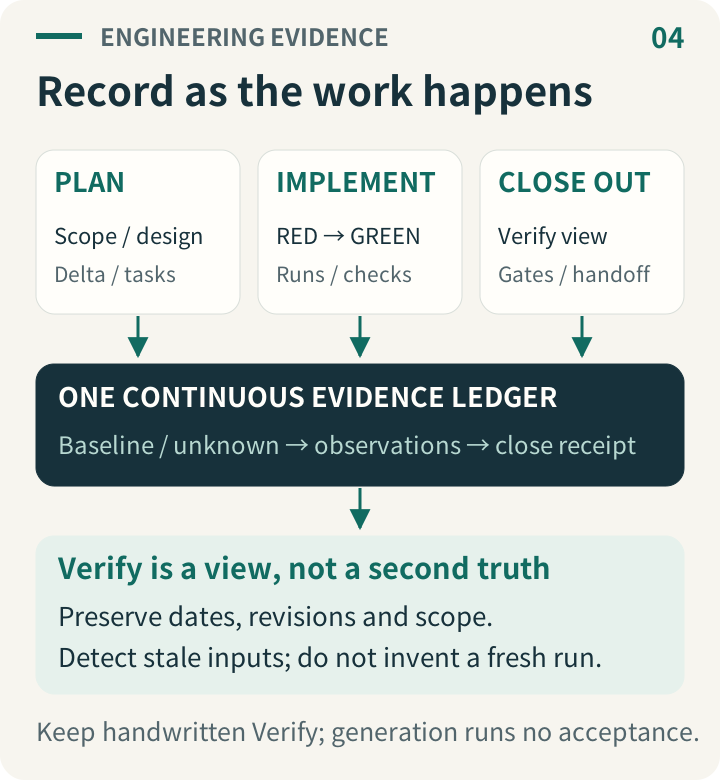
For acceptance, distinguish three objects: the spec promises observable behavior, the code implements it, and execution records describe what was observed on a particular revision. They should align; none can stand in for the other two.
A behavioral RED should reach the intended behavior and fail because that behavior is missing or wrong. A database that never starts or a test that cannot load exposes an environment or assembly failure. Record it honestly, but do not count it as exercising the target behavior. Documentation inspection can use CHECK directly.
Store each observation once
After introducing the ledger, another problem emerged: commands and results were copied into Tasks, Plan, Evidence and Verify. The early-October 2026 closeout change addressed duplicated maintenance rather than adding more acceptance layers.
Tasks owns work state, Evidence owns observations, and Verify owns acceptance conclusions. A plan links necessary execution entry points instead of duplicating commands and results. The original project's spec:verify generates Verify as a projection of the ledger. It preserves original dates and revisions, detects stale inputs, protects handwritten Verify files, and refuses out-of-scope or symlink-traversing writes.
Two kinds of freshness matter. View freshness means Verify agrees with its current inputs. Evidence applicability means those inputs still support the present decision. The generator checks the former, not the latter. Regenerating a view today from an old observation does not produce a new execution today.
The original project divides structural checks into plan, apply and verify: minimum task operability, observations for completed tasks, and consistency between states and conclusions. These checks neither execute product acceptance nor judge model-answer quality. The panorama explains the artifact sequence and complete development path.
The same closeout work distinguished none, candidate and history handoffs. Without a useful new long-term insight, archiving need not manufacture an engineering-history essay. The change has bounded verification and closure records, but no measured reduction in development hours. Its directly explainable value is concentrating maintenance of each fact in one place.
5. When Can Work End? Completion Is Not One Boolean
Implementation, local contracts, live integration, model-quality evaluation, formal closure and release are different dimensions. They do not form a ladder where a PASS automatically promotes the change to the next level.
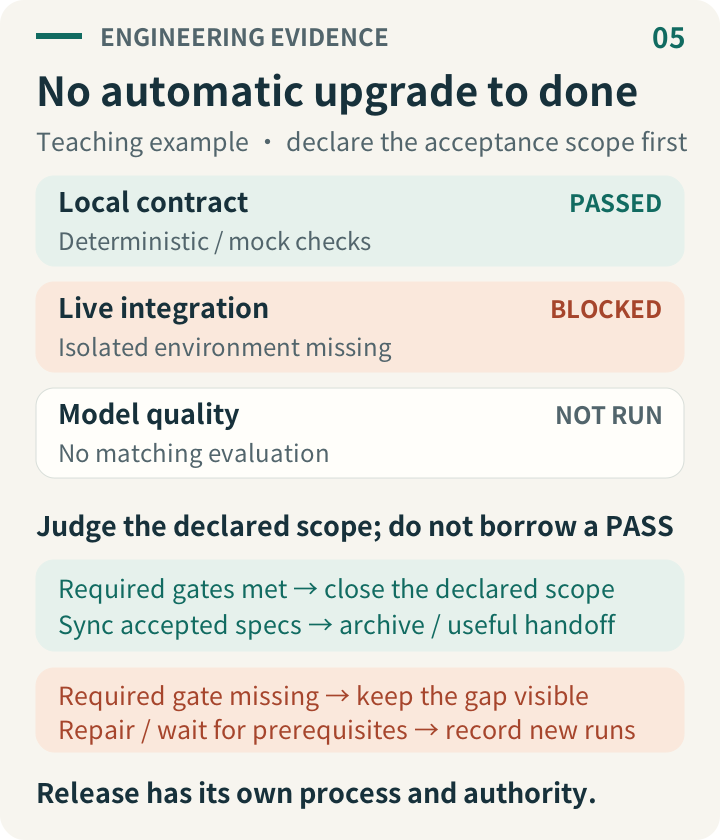
Suppose the agreed commitment is an offline adapter and an authorization-denial contract, with live-provider quality assigned to later independent work. Local acceptance can support that bounded deliverable. But if live-provider integration is part of the present commitment, a blocked integration means that portion remains unfinished. Quietly shrinking scope after a failure cannot fulfill the original promise.
The original project uses a separate spec:close to run the gates required by the declared route. Checked tasks describe task state, not formal closure. Closeout preparation can finish while retaining formal close: not-run. Otherwise, “the task needs a successful close, but closing needs every task checked” creates a circular dependency.
# Original-project entry points: readiness inspection and actual closure differ
pnpm run spec:close:doctor --change example-change
pnpm run spec:close --change example-changespec:close:doctor summarizes static blockers before the first close. It does not run paid models or promote readiness into acceptance. A provider-free route supports declared local deterministic and mock contracts, not long-term live-model quality. When a required condition is unmet, preserve the specific gap, repair the affected behavior or wait for the prerequisite. Independent completed work can still be reported within its actual scope.
When a successful closure receipt already exists and relevant behavior has not changed, archiving can reuse it, synchronize accepted specs and hand off history according to its actual value. Rerunning everything because a summary was edited usually adds no decision-relevant evidence. Newly required checks in the formal plan, changed inputs or concrete failures still need attention.
A stopping condition should be explainable when work begins, not invented when it ends. When current commitments have the support they require, remaining work genuinely lies outside the agreed scope and a successor can inspect the record, the current phase can end. This is the same judgment taught by multi-phase delivery and verification and failure diagnosis: define the commitment and evaluate matching evidence instead of pursuing an ever-larger pass count.
6. Start with the Smallest Useful Evidence Index
First ask whether the existing PR, CI and test reports answer the questions above. If they do, keep using them. Add a ledger and structural checks only where real handoff cost, scattered evidence or risk boundaries justify them.
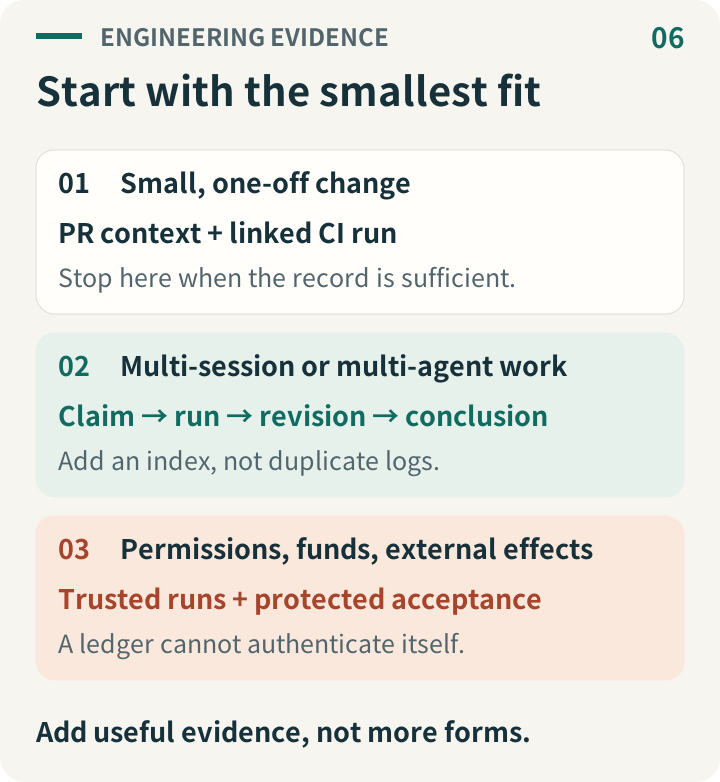
A minimal practice can be small: place observable completion criteria next to the requirement; retain the original run pointer, revision and scope during execution; then link the conclusion to those observations and preserve the unknowns. Do not copy every log or create an entire change directory for each spelling correction.
Where can the public toolkit help?
We extracted task/observation structure checks, Verify generation and recorded-completion inspection into OpenSpec Evidence Kit, now maintained as Spec Flow in Agent Engineering Suite. The unified repository retains the historical v0.1.0 release and migration records. That historical version does not describe the current version or acceptance scope of the entire plugin suite.
Responsibilities remain separate: runners execute; developers or agents record; the CLI checks structure; the project's existing owners decide acceptance and release. The kit does not execute your tests, authenticate observed-run, judge coverage sufficiency or supply the original project's spec:close.
The pinned public source requires Node 26.11.1–26.x, is MIT-licensed, has no runtime dependencies and needs no database or model key. It also works with ordinary local directories. Its optional evidence-driven schema adapts OpenSpec; it does not copy the entire internal superpowers-bridge. The NOTICE attributes related practices, including Superpowers' influence on design and testing.
Run the bundled example before adopting it
These commands pin the source examined for this article rather than relying on future main changes. Skill and plugin installation are covered separately in the guide for this revision.
git clone https://github.com/hpoenixf/agent-engineering-suite.git
cd agent-engineering-suite
git checkout 3b515de2f30e25b1e0757243f3ce4d1be19b00b0
cd skills/aes-spec-flow/toolkit
node bin/spec-evidence.mjs lint --root examples --changes-dir changes --change example --stage apply
node bin/spec-evidence.mjs verify --root examples --changes-dir changes --change example
node bin/spec-evidence.mjs verify --root examples --changes-dir changes --change example --check
node bin/spec-evidence.mjs status --root examples --changes-dir changes --change exampleverify creates examples/changes/example/verify.md; --check compares that view with its inputs. The example's tasks, observations and completion record are fictional format material. Reading recorded-complete means neither that those checks just ran nor that your project passed acceptance.
For adoption, consult the Evidence template and exact field format. Stable task IDs, actual revisions, locatable artifacts and original provenance matter more than the number of fields. Record real observations after execution.
Ordinary completed tasks require ordered RED → GREEN. [check-only] uses CHECK, [baseline-green] uses BASELINE → VERIFY, and [tests-after] explicitly records later VERIFY. A marker cannot approve an exception to project policy, and a historical import cannot become a fresh observation.
lint --stage apply checks phase records and local artifacts for completed tasks. verify generates a view when tasks and observations are usable; verify --check only detects a stale view. status reads the project's authored completion.json, preserving its date, revision and route. It does not rerun checks or compare current source applicability. The tool checks record structure; the project retains acceptance authority.
For the entire suite and module relationships, see the Agent Engineering Suite introduction. Adopt the part that reduces a real handoff burden; the complete workflow is not a prerequisite.
Engineering cannot make every judgment certain. The practical value of evidence is keeping uncertainty visible through handoffs, summaries and closure, instead of quietly rewriting it as established fact. It helps us recognize both when work cannot yet be called complete and when the available evidence is enough to end the current commitment.
The original Chinese URL and complete English edition are retained. Source and engineering discussion live in the GitHub collection; stars welcome.