
Architecture Gallery
Start with the six-layer architecture guide to understand the Native Agent Loop, evidence, publication and durable human interaction; then use this owner gallery to locate individual capabilities. The localized six-layer diagram presents the same story visually.
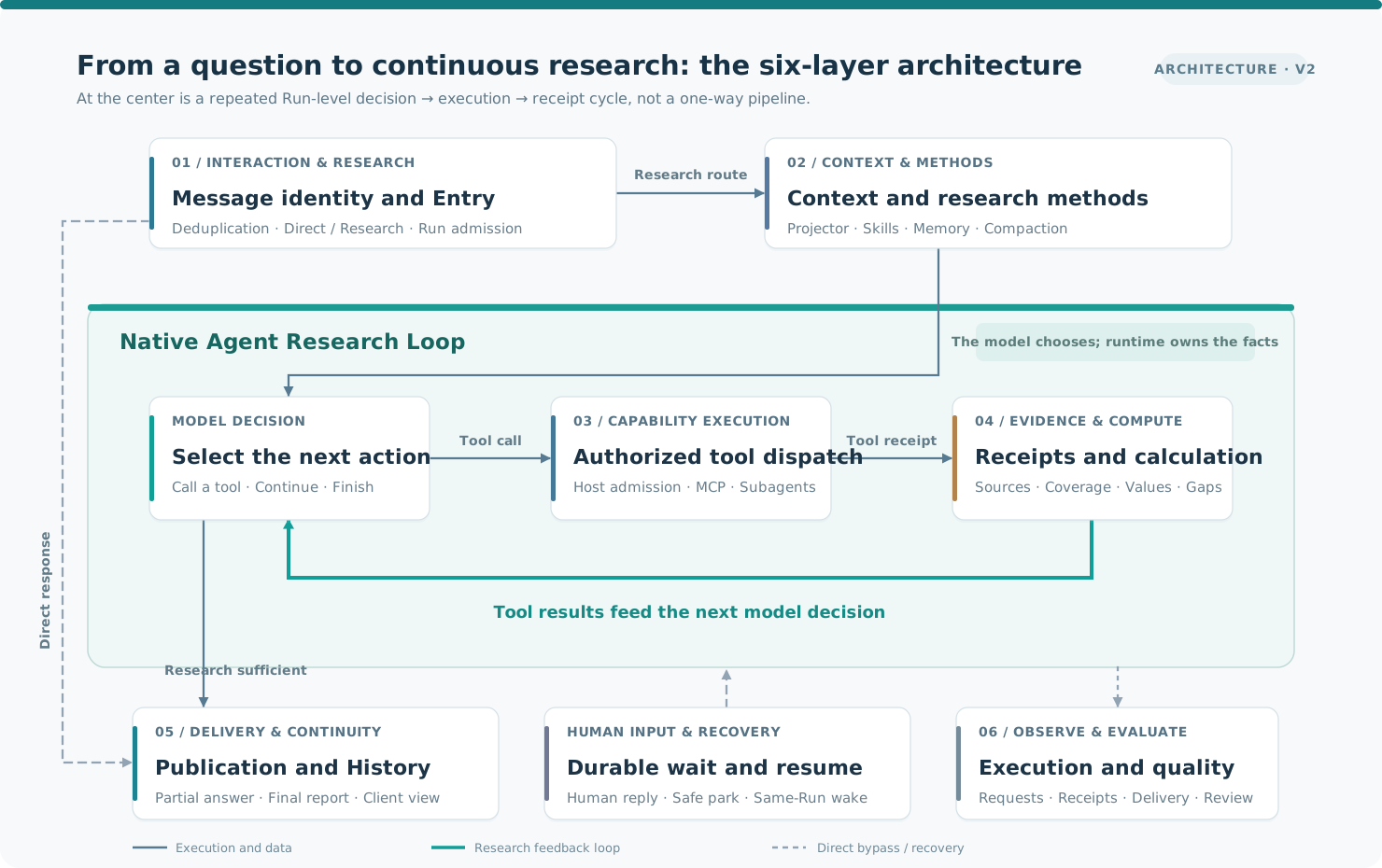
The architecture gallery maps system capability owners, dependencies and article entry points. The interactive diagram currently uses Chinese labels; this English page is a guided entry, not a claim that the source diagram has been translated.
The gallery now identifies 43 capability owners, including A35 Content Security and Trust. Its dedicated English case study explains why source data must not silently become system instructions. The visual labels remain Chinese and are not presented as a fully translated gallery.
October 26, 2026: Scoped source updates and qualification
This is a dated addition, not a revision of the October 25 snapshot. Merged source, a checked task, bounded acceptance, and production readiness are different claims.
| Area | What the latest main supports | What remains open |
|---|---|---|
| Runtime locality | The first Child/Human Interaction handoff ownership slice, run-local Memory session, initial Access/Exposure slice, private Skill session state, and an eight-group field/writer reconciliation are present. Original tasks 1.1, 2.1, 3.1 and 3.2 have their own scoped evidence, including retirement of duplicate Factory Memory internals. | Broader Memory/PostgreSQL recovery, codec/store rule retirement, remaining state privacy and whole-change closure (1.2, 1.3, 2.2, 4.1, E.1) remain open. No measured maintenance-cost reduction or complete production refactor is claimed. |
| Governed page rendering | The original Source reader now has a conditional default rendering fallback, retaining source/security/resource controls and a 1 MiB intermediate rendered-HTML limit. If rendering fails, permitted static evidence may survive with a warning; missing readable content is not treated as success. | Scoped Source evidence does not establish universal dynamic-site coverage, authentication bypass, complete financial research or live browser success rates. |
| Sidecar reference chat | An initially disabled Stage A integration baseline is present on main; the Sidecar A/B/C acceptance tasks remain open. | This is separate from qualified ordinary concurrent conversation interaction and is not an available, accepted Sidecar research experience. |
| Foreground/background interaction | A bounded real-path concurrent-conversation qualification was completed and archived on October 26; short answers, research and control still use original Conversation/Run identity and authority. | An end-to-end fund report with independently verified sources, computation, artifact and History is a separate, unfinished quality question. |
The public status summary is not a substitute for each owning task's exact evidence and scope.
October 25, 2026: Today's updates and pending collaboration
The status board distinguishes bounded engineering outcomes from remaining product qualification. The interactive map still has 43 capability Owners, not newly invented managers.
Completed in scope: Shadow Credits reached its bounded P0 provider-free close, with selected PostgreSQL/browser and non-interference evidence. The custom expert case study is published in both languages; the Subagent study now also covers resource packages and collaboration dependencies. Publications do not close personal Profile tasks.
In progress: Unified experts have three accepted real-dialogue samples: General/Python artifact delivery and two investment-method pairings. Peer, Reviewer and early HIL still have incomplete full-dialogue outcomes; Native cross-process continuation and whole-change close remain open. Foreground short replies and background research reuse the original conversation/Run mechanisms, but the complex research task remains partly delivered.
Awaiting owner work or acceptance: the first independently reviewable public-fund research result (sources, calculations, published answer, actual artifact, fresh History), personal Profile and A36 qualified calendar usage, E04 saved-report cost attribution and Sidecar stages. Runtime decoupling is an architecture review and Spec draft, not a completed production refactor.
New Owner reading entries — A08 and A30
A08 durable control now has its own complete essay explaining claim/fence, original business receipts, delivery ACK and unknown reconciliation; A30 Provider Admission separately explains shared queues, leases and unconfirmed remote completion. Both are existing members of the 43-owner inventory. The Provider architecture article adds A32 catalog/route eligibility as a related topic rather than falsely claiming A32 has a standalone primary essay.
Updated scope — October 24, 2026
With the October 24 inventory decision, the interactive gallery now has 43 distinct capability Owners: A01–A37, B01–B05 and E04. A36 (temporal resolution after semantic selection) and A37 (bidirectional durable Human Interaction) are now first-class logical Owners rather than related notes on older nodes. A36 still lacks final P0 acceptance for a normal, qualified real-agent calendar flow; A37 has a bounded local provider-free close but production Human Park is disabled by default. Neither Owner overrides existing Authorization, Recovery, Effect, data-source or Publication effects. Durable Human Interaction Stages A–D have completed their stated local provider-free formal close and archive, including Child original-text coordination. Production Human Park remains disabled by default, and live model quality and deployment remain unverified. Read the HIL mechanism, A36 temporal semantics (implementation present; real-agent acceptance open), and personal Shadow Credits (bounded P0 engineering close recorded; billing and deployment unverified).
The code paths are not the same as end-to-end acceptance: financial research completion, authenticated account and PostgreSQL recovery, real calendar-source usage, model quality and deployment retain separate evidence requirements. Open a related owner's detail in the Chinese interactive map for the narrower source-level status; this page remains a guide rather than a fully translated diagram.
The gallery's capability owners are not additional architectural principles. Use the core principles and engineering methods for general decisions and the writing roadmap for forthcoming coverage.
For textual introductions, start with architecture thinking or the complete catalog.