
From a Question to a Visible Answer: ETF Agent's Six-Layer Request Lifecycle
The six stages are useful because they separate handoffs—not because they force the model through a fixed pipeline. Who requested the work, who chooses the next step, who performs an effect, and which result can the user actually read? This article follows the current implementation. The stages are a reading map, not six processes, and participation across stages does not transfer authority over permissions, facts or effects.
1. One user question, six processing concerns
Consider a teaching example: a user asks, “Analyze the industry concentration and currency exposure of my fund portfolio.” This illustrates the call relationships, not an investment conclusion or a recorded successful run. The UI appears to do one thing: send, then display an answer. Internally, the system must separately establish which input or event initiated work; whose Run and eligible context it belongs to; what the model decides; which tools or effects execute; which answer revision was accepted and delivered; and what the client rendered.
Read this like the journey from entering a URL to seeing a rendered page: follow the request first, then zoom into branches and loops. A concept question may need a direct answer; missing information may require research; a new message during background work may merely add a constraint. These cases share capabilities without following one fixed route.
Six stages in sixty seconds—without memorizing 47 modules
Imagine a teammate asking: “Compare these two fund reports, tell me what changed, and save the result.” From pressing Send to opening a report, remember six simple questions:
| Everyday view | What the system needs to establish |
|---|---|
| 1. Receive a request | Did this start in chat, on a schedule, or from another event? |
| 2. Know whose work it is | Which sources and tools may this task use, and which research run does it belong to? |
| 3. Choose what to do next | Is a direct explanation enough, or must the assistant read, calculate, or investigate? |
| 4. Actually do the work | Did a tool execute, and what original results did it return? |
| 5. Commit something deliverable | Which answer revision or attachment was accepted and can be read back? |
| 6. Show it to the user | Does the page display the right task and revision, including after reconnection? |
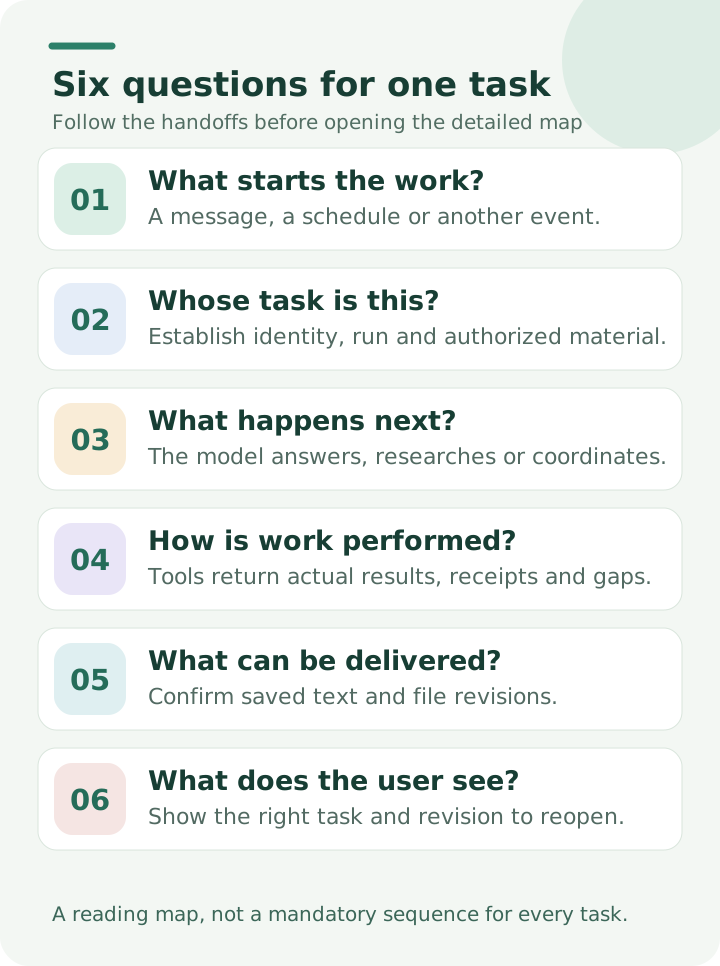
If the second report cannot be read, the assistant may explain the verified part but must not present an incomplete comparison as complete. Saving a report, conversely, does not prove the UI displayed it.
The large diagram below is a reference, not an entrance exam. You can skip its 47 module names at first and follow these six questions through the article. Open the detailed map only when you need to inspect a particular handoff. The six stages are not a mandatory approval pipeline for every question.
Interactive navigation: Select any solid Owner chip to open its dedicated article, or its Owner detail when no dedicated article exists. Dashed notes are not standalone modules. Select “Expand fullscreen” above the map to fit it to the screen, zoom in, or scroll at actual size. Press Esc or “Close” to return to the article; the owner index offers the same destinations.
Open the scalable SVG map: nine reading groups with 47 distinct Owner tags; research/financial tools and identity/authorization share grouped columns.
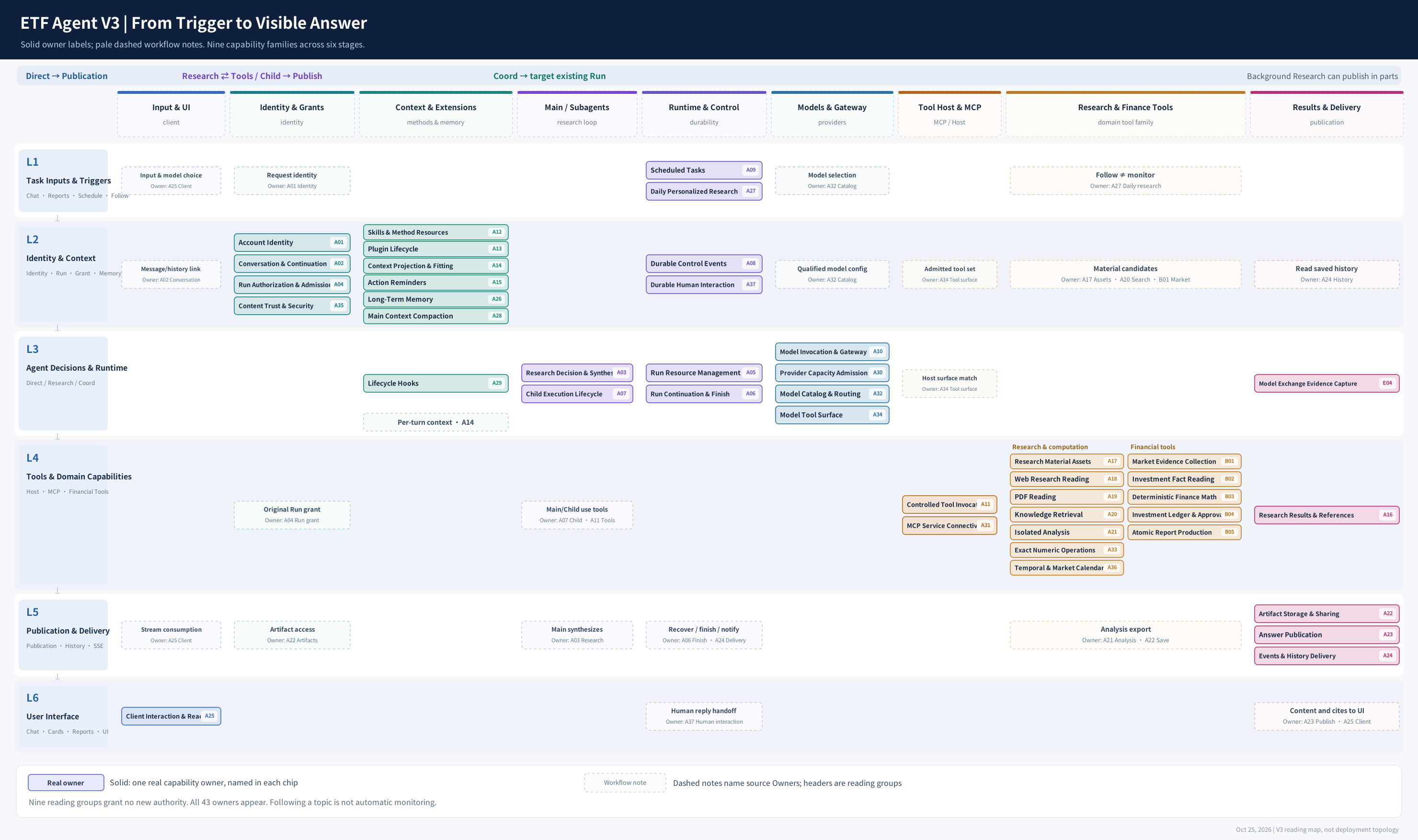
The figure contains six horizontal request-processing bands and vertical capability bars. Each solid chip is a real Owner; its name is primary and its ID is an index. Every dashed workflow note names the Owner(s) it derives from. Dashed column headings are reading groups, not modules. The labels show actual capability names, not cryptic Owner IDs. Reuse across layers does not duplicate authority.
| Stage | Core question | Hand-off |
|---|---|---|
| L1 Task Inputs and Triggers | What starts the Agent's work? | Message, report request, scheduled task or personalized-research trigger |
| L2 Identity, Conversation and Context | Whose task is it, is it allowed and what may it see? | Verified subject, stable Run identity, original grant, eligible context and methods |
| L3 Agent Decision and Runtime | Direct answer, research or coordinate? | Text, research action or targeted control proposal |
| L4 Tools and Domain Capabilities | Who performs external reads, calculations or effects? | Receipts, material, derived results and gaps |
| L5 Publication and Delivery | Which revision was accepted, saved and sent? | Publication, SSE/History, notice or artifact |
| L6 User Interface | Which Run and revision appeared? | Readable answer, status and follow-up controls |
The input composer and model picker also belong to L6, but L1 accepts more than chat: an already accepted Task occurrence may trigger work without a new chat message. L2 validates its identity, Run and grant. The numbering is an explanatory walkthrough, not a requirement to mint a new Run.
2. L1 Task Inputs and Triggers — research need not begin in chat
L1 is where a work request enters the system, not an authentication layer. Input may propose new work or submit a reply, Stop or change to an existing task; receiving it proves neither an applied effect nor the need for a new Run. Someone may send a message, explicitly request a weekly or daily report, or have a previously confirmed schedule reach an eligible occurrence. Each enters the same execution system rather than starting a separate scheduler-driven Agent implementation.
| Input or trigger | Supported capability | Hand-off from L1 |
|---|---|---|
| Chat or explicit Research/Deep request | Client input and conversation submission | Original message and explicit work intent |
| Explicit question, permission or effect-approval response | Durable human-interaction response entry | Original request/revision, authenticated subject and exact answer or choice |
| Stop, change or supplement an existing task | Conversation admission and the original control channel | Explicit target and original input for the original consumer to validate and adopt |
| Expert configuration or selection | Account expert settings and client selection | Configuration version or candidate preference; saving or choosing does not dispatch research |
| On-demand weekly or daily report | User-triggered report and personalized research | Chosen method, original input, date/context candidates |
| Scheduled, recurring or qualified conditional task | Original Schedule / Task owner | Task identity, occurrence and accepted trigger facts |
| Followed topics | Saved Follow strings and daily research selection | Explicit topic preferences as eligible context |
Question and approval responses retain their original request identity; an ordinary chat message saying “yes” cannot approve a bound operation. Response receipt, consumer adoption, permission and business execution each depend on their original receipts; a Stop request is not proof of a stopped task. The expert-configuration Owner remains in L2. L1 shows only its configuration or selection input, not a guarantee that the expert will be invoked.
Following a topic does not by itself start unattended monitoring. Bounded saved-report discovery and home-page readback exist, but continuous subscription-driven generation, a complete digest and its notification experience are not a delivered product promise. Report generation likewise does not mean every report has an authorized timed trigger.
Confirmed recurring tasks have a narrower contract: after an interruption, only the latest eligible occurrence within its grace window is admitted, rather than every missed date becoming backlog. Research completion, the agreed target time and notification delivery are read from their respective records; elapsed time cannot manufacture success.
All inputs converge on the original Task/Conversation, Run, grant, budget, Main/Child and Publication owners. Different triggers must not introduce another execution engine.
3. L2 Identity, Conversation and Context — validate the trigger and prepare the Run
Account Identity validates the actual subject, scope and trustworthy origin of the accepted trigger; a scheduled occurrence retains its confirmed task/account binding rather than bypassing authorization. Conversation Admission and Continuation then creates or reuses a message and Run. Ordinary follow-up, same-message replay, explicit Continue and an existing background task are four distinct relationships. Conversation identity is not the same thing as one execution's identity.
Run Authorization and Capability Admission binds the originally permitted sources and tools. Account Identity answers whose task this is; Run Authorization answers what this Run may use. Both have independent Owners in L2, and no input path bypasses them. Same-Run recovery preserves the established grant, rather than asking a newly generated summary to reauthorize facts.
Context Projection and Fitting assembles the actual model request from admitted history, tool results, provenance and token limits. Long-Term Memory supplies separately governed records and preferences. Main Context Compaction selects, summarizes and commits eligible settled historical turns; its summary does not become a new tool receipt. Action Reminder Coordination offers advice about resource or context pressure, never an extra budget or permission.
Cross-Run conversation compaction supplies source-bound, lossy question–answer history for a new Run while preserving original user text. A summary must still map to its original messages; it creates neither new evidence nor permission. This differs from same-Run Main compaction; see the cross-Run conversation compaction essay.
When the user explicitly references committed research, a new Run can also bind the exact published revision and its admitted sources instead of guessing which report the conversation meant. An unreadable or ineligible reference is omitted locally without blocking an independently authorized answer. Referencing old research does not restore its execution state.
Skill Methods and Resources provide versioned techniques. Plugin Admission and Lifecycle controls which reviewed extension generations can be loaded; Lifecycle Events and Hook Execution runs bounded callbacks at the appropriate seam. None of these may independently grant data access or alter business facts.
Personal experts and presets are prepared here too. Users can save methods and preferences for a personal expert. A new Run freezes the selected revision: Main initially sees a compact directory, and the selected Child receives its method content. Preferred tools and Skills are suggestions, not extra permissions; explicit preloading still obeys resource-read and context-capacity limits.
L2 is revisited before further ModelTurns. Reassembling context is not the same as restarting a Run or minting a new grant.
4. L3 Agent Decision and Runtime — choose a branch, then iterate
The model participates in interpretation here. Research Decision and Synthesis can propose Direct, Research or Coord, but only from the action set allowed by the current authorized conversation snapshot and effective resource configuration. These are conditional branches, not three universal choices.
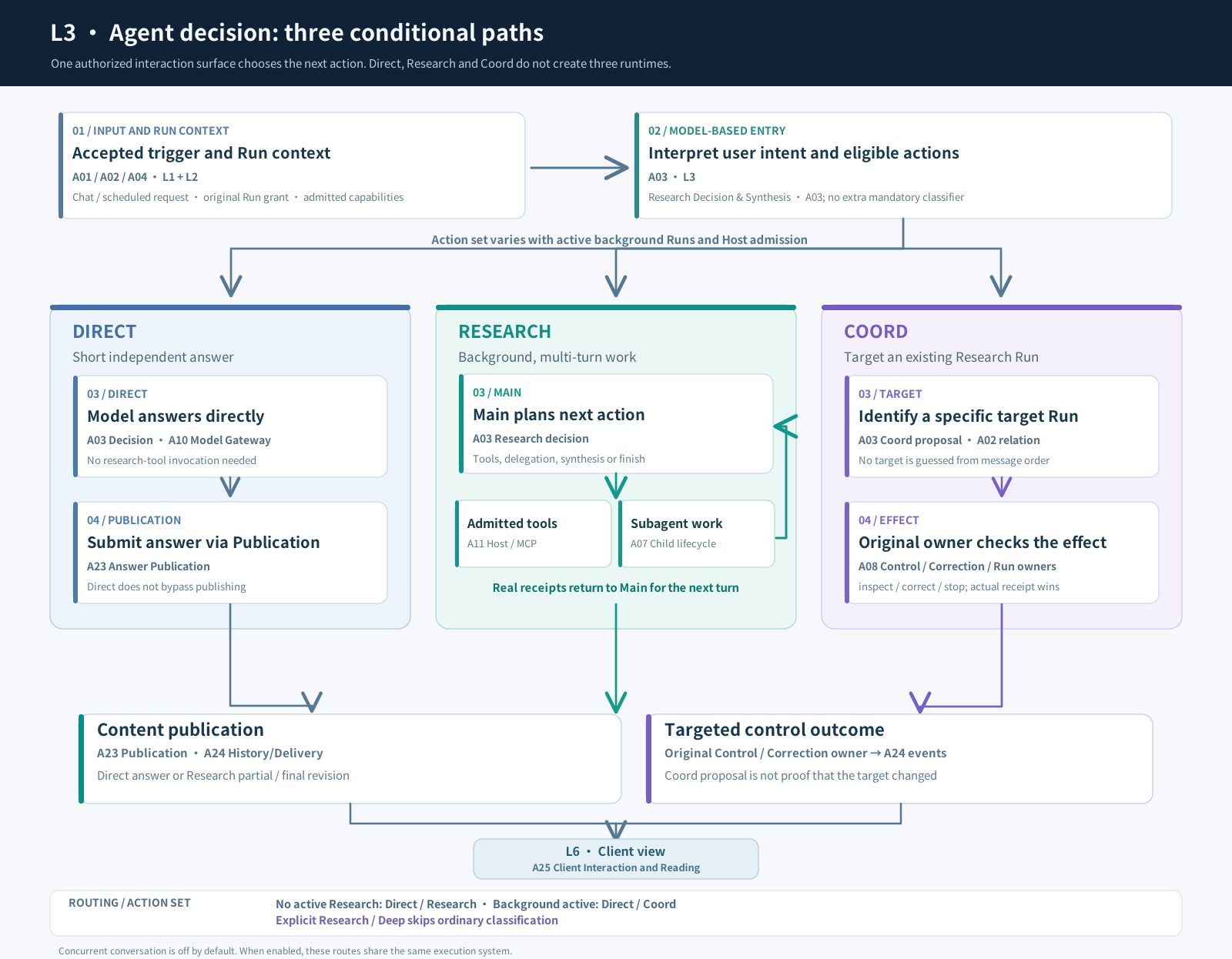
Open the full-size L3 routing diagram
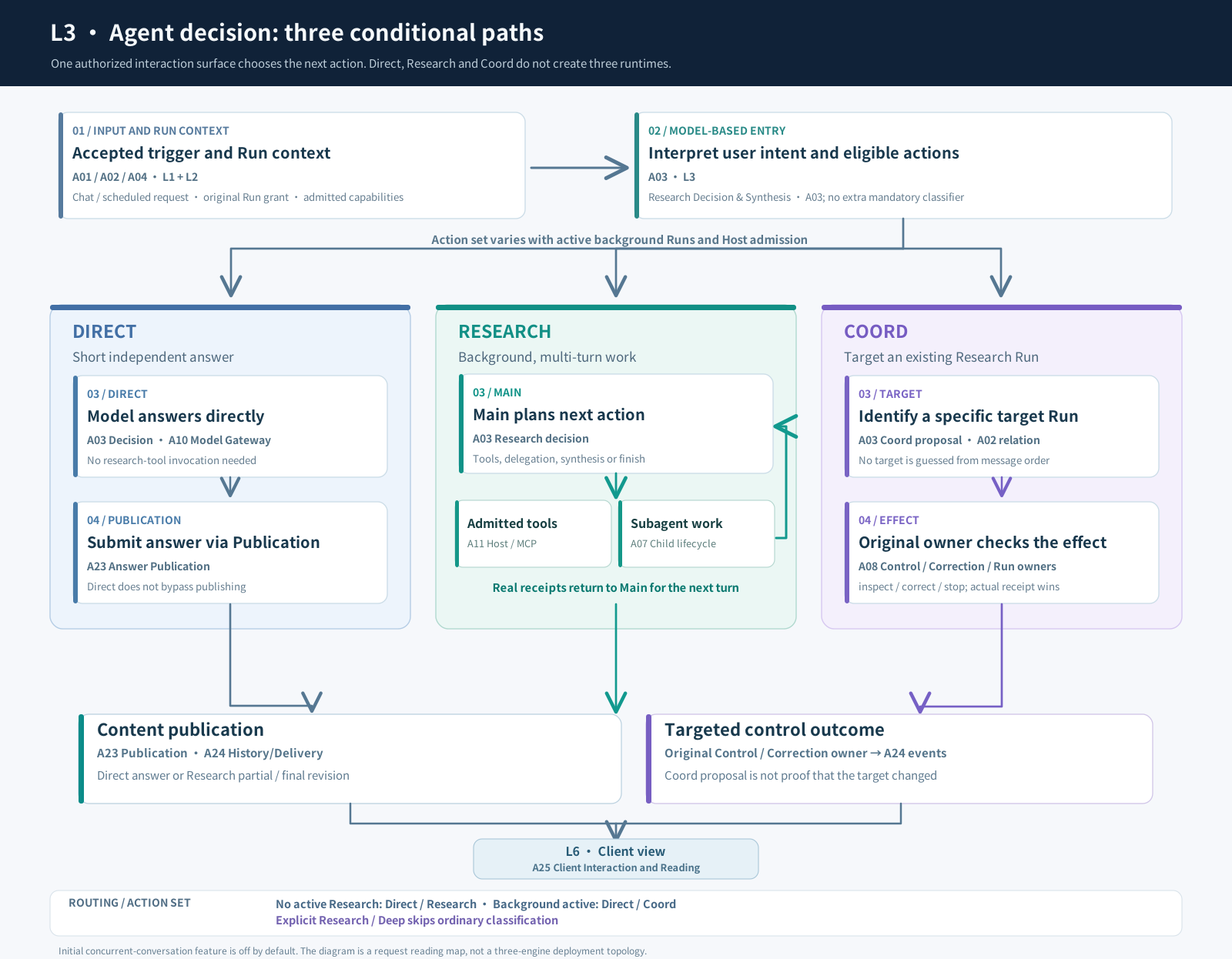
4.1 Direct — still uses a model Gateway, but can skip L4
“What does industry concentration mean?” can be answered directly. Model Catalog and Routing Configuration identifies valid models, provider mappings and declared capabilities; Model Invocation and Request Configuration binds and actually sends the model request through its Gateway; Provider Capacity Admission handles shared supply limits. Run Resource Management accounts for the separate Run budget.
A model selected in the UI does not determine the provider URL or grant an extra tool. Deep approval is a Run resource effect, not a model switch. Requested reasoning effort belongs to an individual model invocation; it does not prove how the provider internally reasoned. Direct can skip Web/PDF/Python or investment tools, but still uses the proper Publication owner.
4.2 Research — Main and subagents jointly do the work
For source-grounded portfolio analysis, Main selects another read, computation, comparison, delegation or synthesis after observing real prior results. The model chooses the research direction; the original runtime executes and settles effects. No additional Supervisor or generic Workflow engine is needed.
Child Execution Lifecycle is a central execution capability: bounded Child identity, model requests, status, retry, cancellation, result binding and handoff. Web, PDF, Python and expert-perspective children can share that mechanism. Main decides whether to delegate and ultimately synthesizes user-facing content; a Child does not own a second Root budget, investment ledger or public publication right.
A Child reading an original report and Main reading only that Child's summary are different evidence-consumption facts. The handoff must preserve actual source and result identities, including gaps and partial results, rather than silently promoting the summary to verified primary evidence.
A Child is not limited to its initial task description. If an assumption fails, it may revise its subsequent task, method hints and relationship description through a staged result, then continue with those descriptions on its next turn. Already sent requests, original user text, permissions and budgets do not change; added material still passes the original source checks. A relationship hint cannot automatically grant access to or control over another Child.
Zoom in: why Research is a loop, not a one-way six-stage pipeline
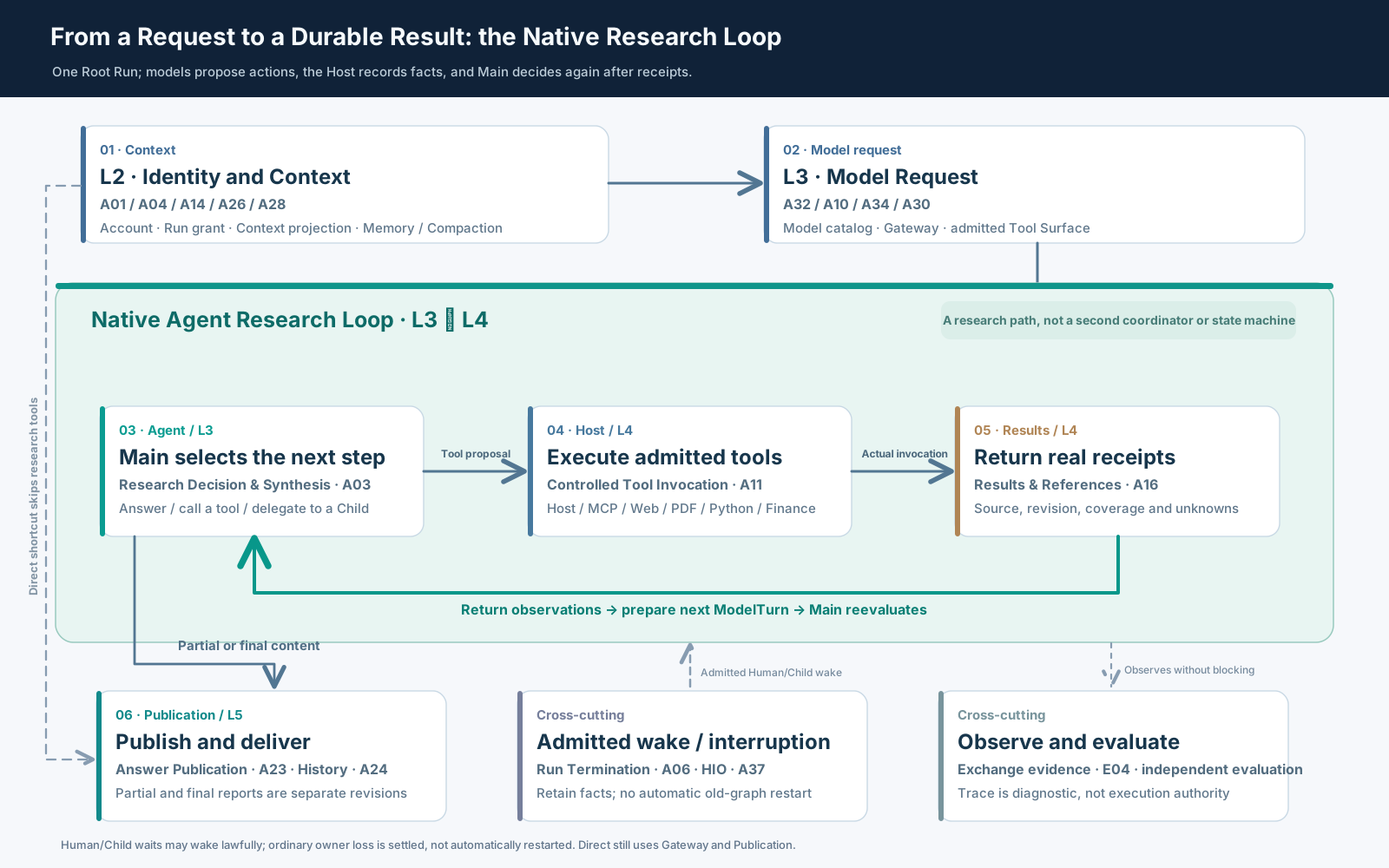
Open the full-size loop illustration
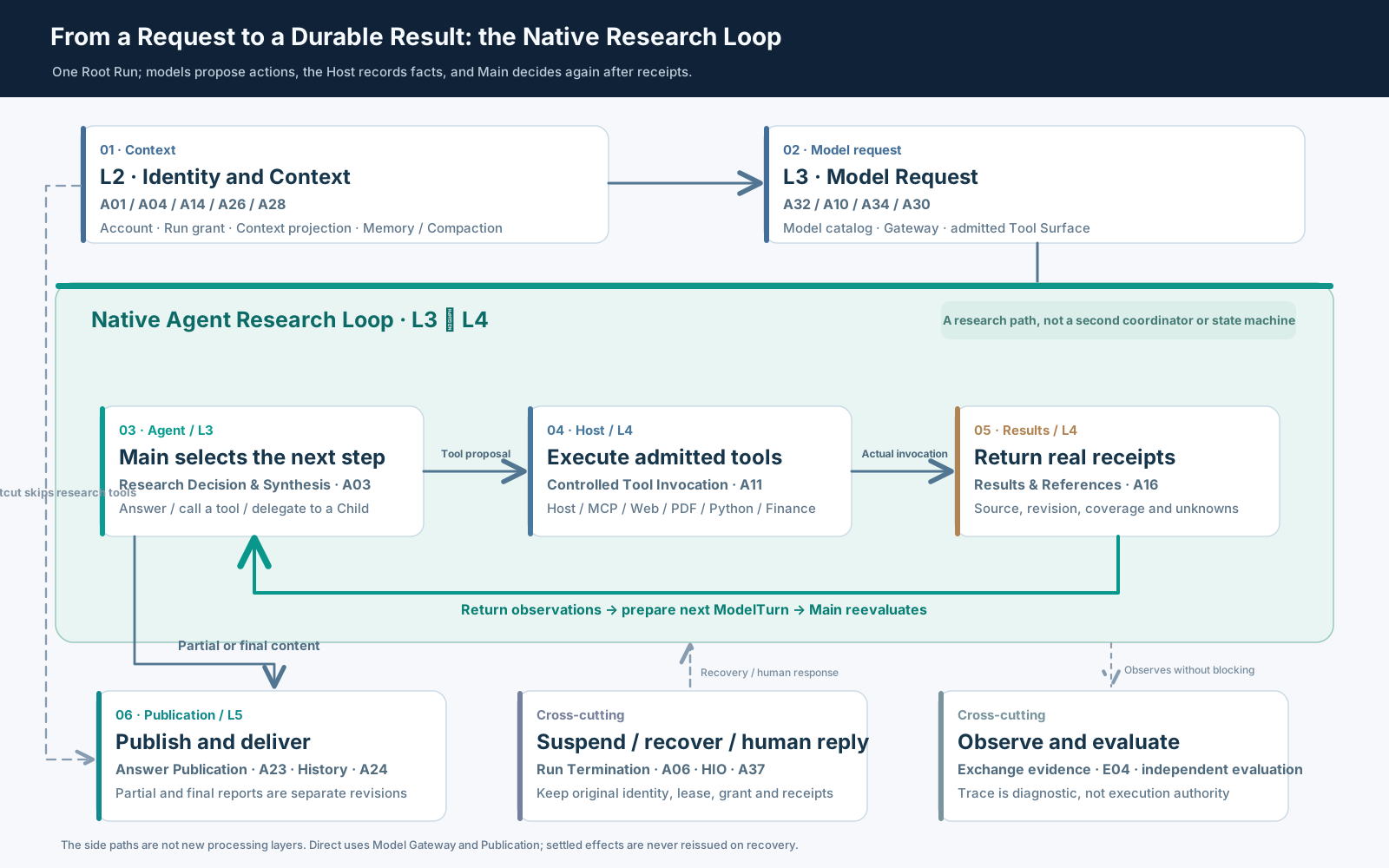
The central loop is Main chooses an action → Host executes → real receipts/results are returned → Main chooses again. Main may delegate a bounded task to a Child; the Child submits local results and source references, while Main decides whether to investigate further or synthesize. One iteration is not the same as a completed Run. Valid partial text may already pass through Publication while Research is still running.
The three lower paths are not sequential phases: Publication owns content revisions, Recovery/HIO distinguishes admitted dependency wakes from interruption settlement, and observation/evaluation explains failures from independent evidence. Sharing a Run does not let these concerns grant each other authority. Direct still uses the model Gateway and Publication; it skips research tools only.
4.2.1 Why research continues, changes course, waits, or finishes
The diagram shows one model turn, action, and observation. The same architecture can also be read at three time scales. These are explanatory perspectives, not three nested schedulers.
| Time scale | Who chooses the next step? | What must remain distinct? |
|---|---|---|
| Within a turn: observation-driven work | Main reads a settled Host result and decides to search again, compute, delegate to a Child, or answer | A successful tool call is not a completed research question |
| Within a Run: research judgment | Main may revise or reopen working questions after contradictory evidence | researchNeeds are model-authored working notes, not certified evidence coverage or a completion/publication gate |
| Across time: waiting and continuation | Admitted Human/Child waits use the original control-wake path; ordinary owner loss is settled as interruption, and explicit Continue starts a linked Run | Saved receipts do not authorize rebuilding an old execution graph in a new process |
Suppose a user asks whether a fund's sector concentration has changed. An article reposted today may describe holdings whose data cutoff was months earlier. Main should distinguish the reposting date, original disclosure date and underlying as-of date, then consult the source, use clearly dated historical data, or explain that the change is unknown. Finding a recent article is not finding current holdings.
This is not an absence of time infrastructure. The current temporal-semantics capability separates current UTC, the immutable task anchor and the user's local date. It selects a valid time zone from the request, account preference and device hint in that order; no trustworthy input means unknown. Account persistence and replay after restart have real storage-backed verification. An official-calendar reader and bounded interpreter also cover Nasdaq's published 2026 regular-session schedule, including holidays and early closes. But a published timetable does not establish actual market opening, cover emergency changes, or prove quote data is current. Ordinary real-model research consuming that calendar end to end remains unverified; this mechanism is not a claim of reliable automatic time judgment.
Finishing also involves distinct decisions: Main judges what to investigate and how to explain remaining uncertainty; CompletionGate and Publication own legal termination, resource limits, partial content and actual delivery. A terminal Run does not certify the financial conclusion, and a resolved working item does not certify task completion. Children, reviewers and peer perspectives remain optional collaboration, not mandatory outer loops.
For how observations change the next research step, see A Research Agent Needs More Than Tools: Model, Harness, and Loop.
4.3 Coord — targeted control, not a third Agent engine
If Research A is already running and the user says “Add currency risk to that analysis,” a new short interaction may propose Coord. It must bind an authorized target Run and an inspect/correct/stop proposal. Durable Control Events, the original Correction/Continue/Termination owners and their receipts still decide what actually happened. Ambiguous targets trigger clarification, not a guess at the last Run.
With the current default capacity settings, ordinary Entry offers Direct/Research without an active background Research, and Direct/Coord with one active background Research. This is the authorized action set, not a global hasBackground classifier. Explicit Research/Deep may bypass ordinary route classification but must still pass background, scope, provider and resource admission.
Coord consumes a short-interaction allowance and may also publish an independent answer. Accepting its message is not evidence that A has incorporated a correction. The real target owner must record the effect.
5. L4 Tools and Domain Capabilities — from proposed call to receipt
A model's “I'll look that up” is only a proposal. Model Capability Presentation and Tool Surface checks what tools the model actually sees against the admitted execution surface. Controlled Tool Invocation validates arguments, dispatches the action and settles an observed receipt. MCP Service Connectivity owns discovery, connection and protocol transport. Neither protocol discovery nor tool visibility grants new permission.
Web Research Reading, PDF Reading, Knowledge Retrieval, Research Material Assets and Isolated Analysis can be assembled as needed. The five B-class financial capabilities are folded into one Financial Tools family for the diagram: market evidence, authorized investment facts, deterministic calculation, ledger/confirmation and atomic reporting. Temporal Semantics and Market Sessions and Exact Numeric Operations are other opt-in tools.
Evidence and computation are not a universal fourth stage through which every answer must pass. These are optional capabilities of L4. Research can call them repeatedly; a simple Direct answer can omit them entirely.
Two facts must remain distinct even in the simplified diagram. Research Results and References preserves ResultRef identity, derivation and source lineage across model turns and publication. Investment Ledger and Confirmation protects real financial changes: model advice cannot replace applicable user confirmation and business authorization.
5.1 Four handoffs that are easy to confuse
A research failure often starts when success at one seam is mistaken for success at another. Consider a fund-document task:
| Handoff | What is actually established | What remains unproven | Primary responsible capability |
|---|---|---|---|
| Model → Gateway | A request returned text or a proposed tool call; completeness is checked against the actual protocol | Half-returned tool arguments are executable, or the provider used the requested internal reasoning effort | Model Invocation and Request Configuration |
| Tool discovery → Host | MCP discovered and described a tool; Host still checks current arguments and Run Grant | Discovery alone granted this user permission to invoke it | MCP Connectivity, Controlled Tool Invocation, Run Authorization |
| Search hit → Source reading | RAG found an attributed candidate excerpt or PDF reader located a page | The entire report and all conditions or missing pages have been checked | Knowledge Retrieval, Research Assets, PDF Reading |
| Tool receipt → Next model turn | Python or a remote tool returned an identified, versioned result with provenance | Execution proves financial methodology is suitable, or a Child summary equals Main reading the original source | Research Results and References, Context Projection |
A further extension constraint matters: a post-tool Hook may narrow what the model sees, but must not silently replace surviving numbers, provenance or their original paths with fabricated facts. A local Hook rejection does not own termination of the entire Run.
When date, coverage or financial methodology is insufficient, Partial or Unknown may be the accurate result. The model interprets gaps, deterministic financial computation owns domain formulae, and Numeric performs only explicitly contracted arithmetic. None automatically certifies the other.
6. L5 Publication and Delivery — generating is not committing
Answer Publication and Preparation owns answer previews, revised content, accepted commits and their receipts. Direct, partial Research publications and final reports share this rule. Private Artifact Storage and Sharing owns separately authorized downloadable file bytes and revisions. Conversation Events and Historical Delivery owns ordered SSE events, replay and background notifications.
Model text, accepted preview, committed body, server delivery event and browser rendering are five distinguishable facts. A well-written candidate is not evidence of user-visible delivery; failure of a later tool does not erase an independently committed earlier answer.
Background Research can continue while foreground messages are answered, publish partial results and deliver a final report later. Time promises such as at/by, research completion and actual notification are separate records. Sending a notice must not rerun research or mint a second report identity.
6.1 First determine what “continue” means
| User-visible situation | Correct system behavior | What must not be substituted |
|---|---|---|
| Research is still running in the background | The original Run continues and may publish partial or final text; a new short question gets its own Run | Automatically cancel earlier Research or reuse one global busy flag |
| A Run is lawfully parked for Human/Child interaction | An accepted control wake restores bounded current-format state with the original budget, grant and receipts | Treat every process restart as an authorized wake, or refresh a deadline for more budget |
| Ordinary research loses its execution owner | The original owner checks lease/fence, settles interruption and returns saved committed content | Automatically rebuild the old execution graph and resend model or tool requests in a new process |
| The original Run is terminal and the user explicitly continues | Conversation/Continue prepares a related new Run with lawfully inherited context and authorization | Pretend the new study was always the same still-running Run |
This is also why Run termination, committed text, notification and browser rendering are four different facts. Observability must use the corresponding real receipts, not one completed value or the last Trace span.
7. L6 User Interface — show the right Run and the right revision
Client Interaction and Reading owns the composer, timeline, citations, cards, background research panel and ordered event/History consumption. A single global busy boolean or the last message in an array cannot explain concurrent Runs.
Research A may remain active while Direct B completes first. B's answer must not overwrite A's publications, and History refresh must reconcile per Run and Publication revision. A displayed answer-preview is not yet a durable commit; server-sent content does not itself prove browser rendering or user reading. L5 owns the legitimate publication; L6 owns client presentation.
The interface also separates selection from participation. Users can search built-in and personal experts, select one precisely, or apply an editable multi-expert preset. The collaboration area shows Children that actually participated, public peer exchanges and managed Reviewer contributions. History preserves the original Run and expert revision. Selection is not invocation, and a preset is not a workflow that forces every expert to run.
Not every read needs new research. An authorized portfolio home can show the original report's allocatable portfolio total, asset groups, estimates and data gaps, together with the confirmed strategy revision from that same report. Opening it starts no model or investment write. The report date and unknowns remain visible: a stale snapshot is not a live account, and displaying a strategy is not a new investment approval.
8. Three messages, three routes
First the user explicitly requests a background source-backed portfolio study. L1 receives the input; L2 authenticates and admits Research A, recording its grant and task identity. L3 Main plans and may delegate PDF reading or Python transformations. L4 returns actual tool and source receipts. L5 publishes a partial and later a final result, shown under A's panel by L6.
Next the user asks “Why does sector concentration matter?” Short interaction B can produce a Direct response without waiting for A or inventing access to A's private, unreleased work. It publishes under B's own identity.
Then the user says “Add FX exposure to A.” Short interaction C proposes Coord. Once the original target owner has accepted the correction, A adopts it at a lawful safe point under its original identity and resource constraints. If A has already terminated, C cannot pretend the old Run changed; the user may explicitly Continue with a related new Run.
Background research, short questions, original-target corrections and separate readback have scoped verification involving a real model, durable History and a browser. Concurrent-conversation mode remains disabled by default. Default short/background capacity is 3/1, subject to Scope totals, interactive-instance admission and Provider capacity. The instance limit is not a cluster-wide limit; scheduled workers and accepted control wakes have separate capacity bounds. These limited observations do not establish production deployment or financial-analysis quality.
9. Vertical capability bars may span stages, or break
The horizontal view says when a concern occurs; Owner identity says who owns the underlying fact or effect. An Owner may legitimately participate in several stages. No diagram cell grants another stage the right to rewrite its facts.
Account Identity and Run Authorization are primarily L2 capabilities. Run Authorization begins there and is consumed when L4 tools and L5 protected publications need it. Long-Term Memory, Context Projection and Main Compaction mainly sit in L2, but may contribute to later L3 model requests. Model Catalog and Gateway primarily support L3, even though the user chooses a model via L6.
Child Execution Lifecycle spans L3 collaboration and L4 tool use. Research Results and References connect tool results to L5 delivery. Publication and Delivery mostly live in L5 and feed L6. Continuous or interrupted vertical bands visualize these touch points rather than imposing a new call sequence.
10. Recovery, governance and observation are cross-cutting—not more numbered layers
Recovery preserves facts; it does not promise to revive arbitrary execution. Browser reconnection waits for or replays existing results. When an ordinary Root loses its execution owner, the system checks lease/fence and settles interruption as partial or failed according to saved content, without rebuilding the old execution graph in a new process. Committed receipts, usage and uncertain external effects remain intact. Only admitted Human/Child control wakes use the retained bounded current-format state. Explicit Continue creates a linked new Run that reuses eligible material, not old execution authority. Control, resources, authorization, Child execution, Publication and History retain their original ownership.
Run Authorization, Run Budget, Provider Capacity, Content Trust and HIO supply constraints and interactions at their own seams, not in a single safety layer. HIO implements requests, authenticated replies and handoff to the original consumer; production Human Park remains disabled by default. A model asking and a user replying do not automatically authorize a source or approve a business effect.
Research Exchange Evidence Capture, Langfuse tracing and independent evaluation provide observation and feedback, not authority to publish, terminate or approve investment effects. A successful request, correct tool invocation, persisted publication and grounded financial conclusion have different evidentiary requirements.
11. What this diagram explains—and what it does not
The six-stage map tells a reader how a question reaches the UI, why Direct may bypass research tools, why Main and subagents are central, and where model selection, Gateway, memory, compaction, authorization, tools, delivery and rendering sit. Background work can outlast an immediate foreground answer without introducing another pipeline.
The illustration is not the full call graph, deployment topology, authoritative owner map or a live-quality report. Related modules are grouped into readable vertical families and B-class financial owners are presented as one Financial Tools family. Their distinct contracts still live in the original Owner registry.
For design and debugging, ask three questions: What did the model actually receive? Which owner accepted the effect? Which result can the user reopen? This is more useful than finding one success flag per stage. Tool success does not prove research sufficiency, process restart grants no old execution authority, and generated text is not completed delivery.
Appendix: the 47 capability owners by primary stage
The original capability Owner registry is authoritative for effects and facts. This appendix assigns each to one primary stage for orientation, and shows other stages it touches without inventing parent authority.
L1 · Task Inputs and Triggers
| ID | Capability owner | Other stages |
|---|---|---|
| A09 | Scheduled Tasks · Owner details | L2, L3, L5 |
| A27 | Daily Personalized Research | L2, L3, L5 |
L2 · Identity, Conversation and Context
| ID | Capability owner | Other stages |
|---|---|---|
| A01 | Account Identity · Related reading | L1, L4 |
| A02 | Conversation Admission and Continuation · Related reading | L1, L5, L6 |
| A04 | Run Authorization and Capability Admission · Owner details | L1, L3, L4, L5 |
| A08 | Durable Control Events · Owner details | L1, L3, L5 |
| A12 | Skill Methods and Resources · Related reading | L3, L4 |
| A13 | Plugin Admission and Lifecycle · Owner details | L3, L4 |
| A14 | Context Projection and Fitting · Owner details | L3 |
| A15 | Action Reminder Coordination · Deep dive | L3 |
| A26 | Long-Term Memory · Owner details | L3, L4 |
| A28 | Main Context Compaction · Owner details | L3 |
| A41 | Cross-Run Conversation History Compaction · Owner details | L3 |
| A35 | Content Trust and Security Policy · Owner details | L3, L4 |
| A37 | Durable Human Interaction (HIO) · Owner details | L1, L3, L5, L6 |
| A39 | User Expert Profiles and Presets | L1, L3, L4 |
| A38 | Personal Credits Account and Usage Attribution | L3, L6 |
L3 · Agent Decision and Runtime
| ID | Capability owner | Other stages |
|---|---|---|
| A03 | Research Decision and Synthesis · Owner details | L2, L4, L5 |
| A05 | Run Resource Management (Deep) · Owner details | L2, L4, L5 |
| A06 | Run Continuation and Termination · Owner details | L2, L5 |
| A07 | Child Execution Lifecycle · Owner details | L2, L4 |
| A10 | Model Invocation and Request Configuration · Owner details | L2 |
| A29 | Lifecycle Events and Hook Execution · Owner details | L2, L4 |
| A30 | Provider Capacity Admission · Owner details | L2 |
| A32 | Model Catalog and Routing Configuration · Related reading | L1, L2 |
| A34 | Model Capability Presentation and Tool Surface · Owner details | L2, L4 |
| E04 | Research Exchange Evidence Capture and Readback · Related reading | L4, L5 |
L4 · Tools and Domain Capabilities
| ID | Capability owner | Other stages |
|---|---|---|
| A11 | Controlled Tool Invocation · Owner details | L2, L3 |
| A16 | Research Results and References · Owner details | L3, L5 |
| A17 | Research Material Assets · Related reading | L2 |
| A18 | Web Research Reading · Owner details | L3 |
| A19 | PDF Reading · Owner details | L3 |
| A20 | Knowledge Retrieval · Related reading | L2, L3 |
| A21 | Isolated Analysis · Owner details | L3, L5 |
| A31 | MCP Service Connectivity · Owner details | L2, L3 |
| A33 | Exact Numeric Operations · Related reading | L3 |
| A36 | Temporal Semantics and Market Sessions · Owner details | L2, L3 |
| B01 | Market Evidence Collection · Owner details | L2, L3 |
| B02 | Investment Fact Reading · Owner details | L3 |
| B03 | Deterministic Investment Calculations · Owner details · Related reading | L3 |
| B04 | Investment Ledger and Confirmation · Related reading | L6 |
| B05 | Atomic Report Production · Related reading | L3, L5 |
L5 · Publication and Delivery
| ID | Capability owner | Other stages |
|---|---|---|
| A22 | Private Artifact Storage and Sharing · Owner details | L4, L6 |
| A23 | Answer Publication and Preparation · Owner details | L3, L4, L6 |
| A24 | Conversation Events and Historical Delivery · Owner details | L2, L6 |
| A40 | User Answer Feedback Records · Owner details | L2, L6 |
L6 · User Interface
| ID | Capability owner | Other stages |
|---|---|---|
| A25 | Client Interaction and Reading · Related reading | L1, L2, L5 |
Engineering navigation E01–E03 is not counted among these 47 production capability owners. Each owner's specification and verification evidence remain the source for implementation, scoped testing and production availability.
Two judgments run across all six stages: Model judgment must not replace recorded execution authority, and the user's actually delivered result is the measure of completion. Generated text, committed answer content and what the client can read require separate checks; a stage cannot certify the whole task by succeeding locally.
Owner gallery · GitHub engineering library
Getting started: continue in order
Previous: After the report: source checks, specialist work, and independent review.